

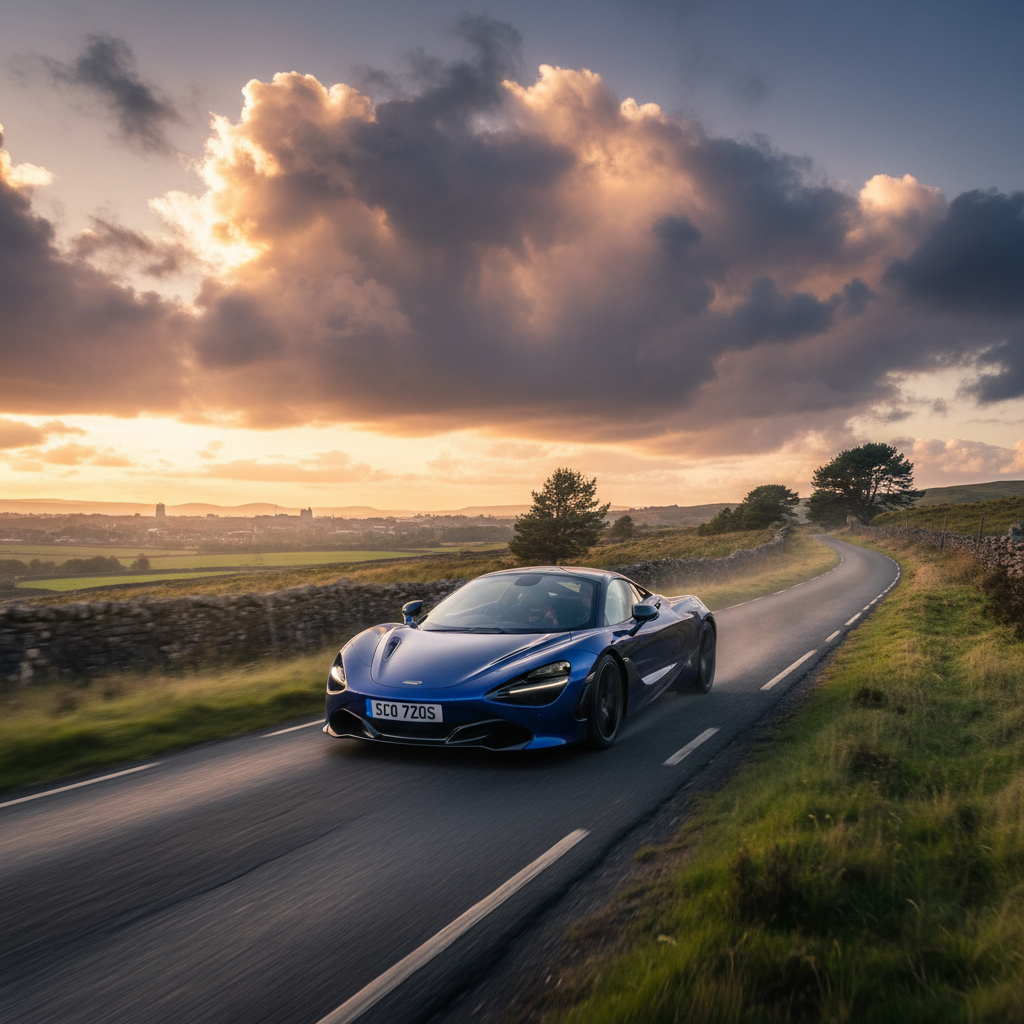
If you live for that perfect apex, you know the feeling. It’s not about the digital readout on the dashboard; it’s about the brief, magical conversation between your palms, the front contact patches, and the tarmac beneath you. But the performance car landscape is shifting beneath our feet. We are staring down the barrel of an era where a family hatchback can out-accelerate a decade-old hypercar, forcing us to ask a crucial question: has raw, ballistic power officially overtaken the delicate art of chassis dynamics?
The 1,584bhp Elephant in the Room
Look no further than China’s latest weapon, the Denza Z. As reported by Autocar, this zero-emission brute boasts an absolutely mind-boggling 1,584bhp. That is a Chiron-baiting power output wrapped in a package designed to target the benchmark of sports car royalty: the Porsche 911. Priced at a cool £173,000, it aims to redefine what we expect from high-end performance.
Can a heavy, high-horsepower EV deliver that razor-sharp, responsive front-end feel we crave? Or does it rely on digital torque-vectoring wizardry to mask its mass? The true test lies in the steering rack and the suspension geometry. A car must feel planted and natural, allowing the driver to lean on the chassis with confidence rather than fighting a computer that is constantly trying to save you from physics.
The Paradox of Choice: Navigating the 911 Grid
Meanwhile, Porsche continues to refine the analogue-to-digital spectrum, albeit in a very different way. According to Autocar, there are now 21 different flavours of the Porsche 911. Navigating this line-up has become a minefield for the enthusiast driver, where buying the 'wrong' variant is easier than you might think.
Do you want the everyday usability of a Carrera, the continent-crushing, effortless torque of a Turbo S, or the raw, motorsport-derived motorsport philosophy of a GT3? Each occupies a distinct niche in driving dynamics:
- The Carrera: Often the sweat spot for the road, offering a supple ride and enough lateral grip to exploit on a classic B-road without losing your licence.
- The Turbo S: A point-and-shoot weapon with all-wheel-drive security, delivering a relentless surge of power that makes overtaking laughably simple.
- The GT3: A mechanical masterpiece with a naturally aspirated engine and a double-wishbone front suspension setup that offers unparalleled feedback through the steering wheel.
The lesson here is simple: more money or more power doesn't always equal more fun. A £100k Carrera with a manual gearbox might just offer a more engaging, connected drive on a damp Tuesday in Wales than a £180k Turbo S or a 1,500bhp electric hyper-saloon.
Lessons from the Track: Balance Always Wins
This battle between raw power and pure balance isn't just limited to the road. Look at top-tier motorsport. In the World Endurance Championship, Autosport reported that Cadillac secured a stunning front-row lockout at the Six Hours of Brazil, with Will Stevens pipping Jack Aitken for pole. Despite competing against teams with different hybrid layouts and power delivery systems, it was the Cadillac V-Series.R’s superb chassis balance around the demanding Interlagol circuit that made the difference.
Even in MotoGP, where the rider's body acts as the ultimate dampening tool, the hunt for mechanical harmony is fierce. Following Marc Marquez’s dominant sprint victory at the Sachsenring, as detailed by Autosport, riders like Alex Marquez noted how changes to starting grid rules have made overtaking incredibly difficult. When the machinery is this closely matched, and the electronics are this advanced, finding that extra tenth of a second comes down to pure, unadulterated mechanical grip and rider bravery—not just a bigger engine.
The Verdict: What Makes a Car Truly Great?
As performance car editors, we are privileged to test the wildest machines on earth. But the cars that stick with us aren't the ones with the biggest numbers on the spec sheet. They are the ones that talk to you. They are the cars with a responsive throttle, a brake pedal that firm up beautifully under pressure, and a chassis that feels like an extension of your own body.
Key Takeaways for the Petrolhead
- Power isn't everything: A 1,584bhp EV like the Denza Z sounds impressive, but managing that weight in the corners is the real engineering battle. For a deeper dive into this concept, check out our piece on Mass vs. Mastery: Why Chassis Engineering is the Ultimate Battleground for Driver Joy.
- The 911 sweet spot: With 21 models available, the purest driving experience often lies in the simpler, lighter Carrera or GT variants rather than the heavy, high-tech flagships.
- Mechanical connection: True driving engagement comes from suspension geometry and steering calibration, not just software-defined torque vectoring. This echoes the sentiments explored in Goodwood’s Mechanical Symphony and the Changing Landscape of Pure Driver Engagement.
- Chassis balance is king: As proven by Cadillac in WEC, a stable, predictable platform will always conquer raw, unruly power when the going gets tough.
So, if you are looking to park a new performance icon in your garage, don't get blinded by the bhp race. Look for the engineering depth, the weight distribution, and the passion of the engineers who tuned the dampers. That is where real speed, and real joy, is found. This pursuit of innate connection is precisely what we discussed in Pure Magic vs. Silent Might: Why the Soul of Driving Has Never Been More Under Siege.